64.45
Atlanta


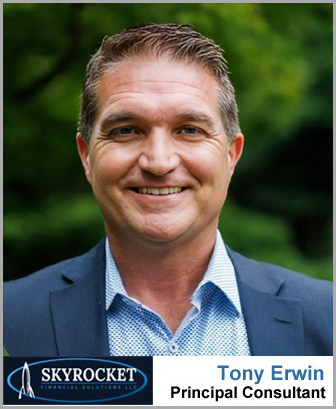

A whirlwind of change is occurring in technology and finance, says Tony Erwin, because of the adoption of blockchain and stablecoins. “Companies will have no choice but to find a strategy for dealing with this. Everything is moving to tokenization, even at the central bank level,” he says. “The good news is that because of Georgia’s experience in payments and fintech, we can lead the way – preserving our transaction leadership.”
Erwin serves as the state of Georgia representative to the U.S. Blockchain Coalition and North American Blockchain Association and is a Certified Blockchain Architect plus holds the CBDA designation. His company, Skyrocket Financial, works with businesses to identify and implement important AI and blockchain initiatives to improve corporate efficiency, develop new products, open new markets and – most important of all – decide and implement their strategy for the future of money.
“Most individuals and businesses are missing the shift in financial infrastructure happening now,” says Erwin. “This shift is the movement from traditional finance to on-chain finance. But the central banks, big banks, and major financial institutions are not missing it. They are driving it. Most CEOs and CFOs are simply not aware of how quickly the shift is occurring.”
In order to face the reality of what is happening, Erwin believes that C-level executives need to separate the “wild west” aspects of cryptocurrency in their minds from the benefits of blockchain technology. “Think of it this way,” he says, “in this country, we really did have a ‘wild west’ after the Civil War, but that was only a small part of what was happening in the country from 1865 to 1900. The much larger reality was that the US was becoming the industrial and economic leader of the world. Back then it was driven by physical “rails” (railroads), now it is software and financial “rails”.
“Financial and fintech companies need to move quickly, of course,” says Erwin, “but on-chain infrastructure will soon affect all companies.” Treasury management still runs at the speed of decades-old banking infrastructure but needs to move at the speed of business, which is internet speed. “On-chain treasury management opens up many new yield opportunities and closes the speed gap,” says Erwin. “Settlement collapses from days to seconds – around the clock, including weekends – on infrastructure that is programmable, continuous, instant and auditable by nature.”
The two main drivers of blockchain use are Collateral Mobility and Programmable Money, says Erwin.
Collateral is often used in financial transactions – to back a trade, meet a margin call or secure financing. Today, the legacy process of posting collateral to execute the transaction can take hours or days. By tokenizing collateral on the blockchain, transfers, pledges, and settlements can occur instantly – making for much more efficient use of capital and higher profitability.
Programmable money means tokenized money. Once money is tokenized, software can act on it, allowing institutions to gain a level of speed and efficiency that legacy companies cannot hope to match. Workflows that previously required reconciling records across institutions to manually settle a transaction will become a thing of the past.
Listed below are just a few of the indicators that Erwin points to that illustrate where the world is moving:
• The Federal Reserve is looking at distributed ledgers for ways to use the technology to upgrade its own systems.
• The BIS (Bank for International Settlements) is now spearheading large-scale collaborative projects, such as:
Project Agora: Involving 40 commercial banks and 7 central banks to dramatically streamline cross-border payments based on tokenization.
https://www.bis.org/about/bisih/projects.htm?m=268
Project Pine: Exploring the integration of wholesale CBDCs, commercial bank digital money, and government securities in a tokenized fashion.
https://www.bis.org/about/bisih/topics/fmis/pine.htm
• Larry Fink, the CEO of BlackRock (the largest asset manager in the world), said less than a year ago that “The tokenization of assets is in its very early stages, but it’s happening very quickly. I believe every financial asset will eventually be tokenized."
• In January, the New York Stock Exchange announced that it would tokenize securities to allow 24x7 trading of U.S. listed equities and ETFs, fractional share trading, and offer immediate settlement.
• The Securities & Exchange Commission has issued a no-action letter allowing the Depository Trust & Clearing Corporation (DTCC), the premier post-trade market infrastructure for the global financial services industry, to begin tokenizing assets. DTCC settles the vast majority of securities transactions in the United States and $2.50 quadrillion in value worldwide, making it by far the highest financial value processor in the world. DTCC is launching its tokenization service in a two-phase rollout. Phase 1 begins in July 2026 with full commercial launch in October 2026.
https://www.dtcc.com/news/2026/may/04/dtcc-advances-development-of-new-tokenization-service
When working with new clients, Erwin and his team begin with a one-to two-hour workshop with client senior leaders where they explain what blockchain technology is, where it fits in with the client’s business model, as well as industry developments that they should be aware of.
Depending on how the workshop goes, Erwin and team will then help develop a blockchain strategy to determine whether and when blockchain should be implemented, the foreseeable future. “If necessary, we bring in a team of blockchain developers and map out applications that will be important over time,” he says.
Excited about the future, Erwin looks forward to the challenge of getting companies blockchain-ready. “And I genuinely believe that Atlanta can be the leader in this new industry,” he says.
Erwin is the co-founder of FutureTech Georgia (https://futuretechga.org/) and has more than 20 years of Silicon Valley technology experience. He is also a co-author of a book on sustainability and financial technology.

© Copyright 2026, All Rights Reserved